
From Filling and Seaming to Shelf Life: Unlocking How Aluminum Cans Lock in CO₂, Barrier Oxygen, and Protect Beverage Flavor Profile
In our previous feature, we explored why aluminum cans are rapidly capturing market share among global beverage brands.
However, a fundamental question often arises for procurement managers and brand founders:
Are aluminum cans merely visually appealing, or is there hard engineering at play?
For craft beer, carbonated soft drinks (CSDs), sparkling water, energy drinks, and Ready-to-Drink (RTD) cocktails, the true measure of a packaging format lies in performance invisible to the casual consumer: carbonation retention, oxygen barrier capability, light blocking, and hermetic sealing.
From the moment a beverage leaves the automated filling line to when it reaches the consumer’s hand, it may spend weeks or months undergoing maritime transport, warehousing, and retail shelf display. If a container cannot precisely regulate gas exchange, the product’s taste, aroma, and freshness degrade long before its appearance does.
So, how exactly does an aluminum container preserve these delicate flavor profiles?
Following our ongoing ERJIN PACK Aluminum Can Lifecycle Series, this article breaks down the complete chain: Filling →Gas Management → Double Seaming → Storage → Consumption.
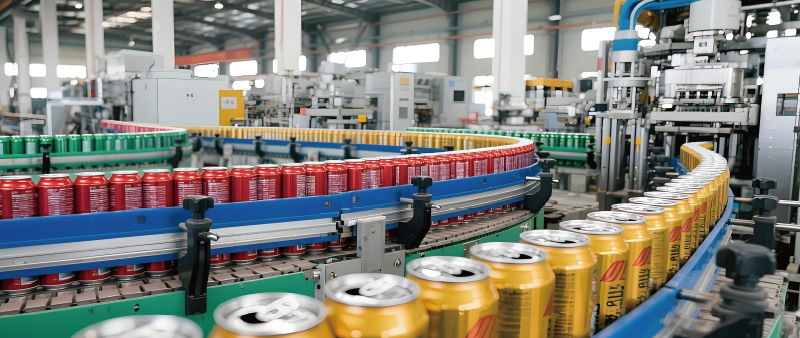
I. Why Aluminum Cans Excel for Beer, CSDs, and Sparkling Beverages
When evaluating metal containers for the first time, most buyers point to obvious advantages: light weight, shatterproof nature, modern shelf presence, and optimized freight logistics.
While those factors drive supply chain efficiency, beverage formulators favor aluminum for a more critical reason: It creates an absolute physical barrier against light, oxygen, and gas migration.
Aluminum alloy possesses near-zero gas and light permeability. Unlike certain plastic polymer containers (such as PET), which experience micro-permeation of oxygen inward and carbon dioxide outward over time, high-performance aluminum containers eliminate atmospheric diffusion.
+---------------------------------------------------------------------------------+
|                       ALUMINUM BARRIER PERFORMANCE MATRIX                       |
+-----------------------------------+---------------------------------------------+
| CO₂ Migration (Carbonation Loss)  | ZERO diffusion through bare metal body      |
| O₂ Ingress (Oxidation Risk)       | 100% Hermetic Block when properly seamed    |
| UV / Ambient Light Penetration    | Complete opacity (Prevents "Lightstruck")   |
| Volatile Flavor Compound Escapes  | Total confinement within internal lining    |
+-----------------------------------+---------------------------------------------+
For sensitive beverage formulations—particularly craft beer, carbonated soft drinks, sparkling water, functional energy drinks, and RTD cocktails—the container is not merely a passive vessel. It is an active component of shelf-life management.
II. The Critical Role of CO₂ Retention
Crack open an ice-cold beverage, and you hear the signature hiss—one of the most recognizable sensory cues in consumer packaging.
Where Does That Pressure Release Originate?
In carbonated beverages, carbon dioxide gas is not simply sitting in the empty space; it is dissolved into the liquid matrix under specific pressure and temperature parameters.
When a consumer opens the tab:
-
Internal headspace pressure drops instantly to atmospheric levels.
-
Dissolved CO2 converts into gaseous phase.
-
Bubbles rise rapidly to create mouthfeel and effervescence.
[ High-Pressure Closed Can ] ──( Tab Pulled )──> [ Pressure Drop ] ──> [ CO₂ Release & Effervescence ]
What Happens If CO₂ Escapes During Storage?
If a container suffers minor seam defects or micro-porosity, dissolved gas steadily bleeds out over its warehouse shelf life. The beverage turns flat, loses its characteristic carbonic bite, and alters the consumer’s perception of product freshness.
Therefore, professional beverage packaging engineering requires managing more than container integrity. It demands optimizing filling line carbonation levels, internal line pressure, headspace volume, seaming mechanical tolerances, and thermal storage conditions.
This is why a professional aluminum can supplier must look beyond unit pricing and visual printing. Success depends on the complete system:
III. How Lightweight Can Engineering Holds Internal Pressure
A common misconception is that aluminum cans retain gas because they have thick, heavy walls.
In reality, modern packaging design relies heavily on structural lightweighting. Sidewalls are drawn down to ultra-thin gauges (as thin as $0.09mm to 0.10mm). Pressure integrity is maintained through engineered geometric features:
-
High-Tensile 3104/5182 Aluminum Alloys
-
DWI (Drawn and Wall Ironing) Mechanical Strain-Hardening
-
Inward-Curved Base Dome Geometry (Distributes Internal Loads)
-
Precision Die-Necking Profiles
-
Double-Seam Interlocking Mechanical Seals
Even with superior raw material barrier properties, if the mechanical seam fails, gas escapes and the system collapses. The pivotal stage in preserving carbonation occurs at the filling plant during Double Seaming.
IV. The Mechanics of Double Seaming
Once liquid fills the body, an easy-open end (lid) is placed onto the flanged container rim. The assembly enters the seaming station, where two sequential mechanical rolls interlock the components into a gas-tight seal.
1ST OPERATION: Interlocks the Lid Hook with the Can Body Flange
┌──────────┐  <-- Lid Hook
│  ┌───────┘
│  │ ┌─────┐
└──┴─┼─────┤  <-- Body Flange
     └─────┘

2ND OPERATION: Compresses Metal Layers & Activates Polymer Compound
┌──────────┐
│┌────────┐│
││┌──────┐││  <-- Fully Compressed 5-Layer Hermetic Joint
└┴┴──────┴┴┘
-
First Operation Roll: Folds the lid curl under the can flange to form a loose, interlocked hook.
-
Second Operation Roll: Applies high pressure to flatten and compress the five layers of metal together, squeezing the liquid sealant compound inside the lid curl to bridge any micro-voids.
Why Is Seam Quality Critical?
For carbonated liquids, seam integrity dictates product viability. Out-of-spec seaming dimensions (such as improper seam length, countersink depth, or thickness) lead directly to:
-
CO2 pressure loss and flat product
-
Liquid leakage and carton damage
-
Atmospheric oxygen ingress
-
Accelerated internal corrosion risks
-
Reduced micro-biological shelf stability
In commercial beverage manufacturing, automated optical seam inspection and destructive tear-down audits are non-negotiable quality control gates.
V. Managing Dissolved Oxygen (DO) to Prevent Flavor Degradation
If carbonation determines effervescence, Dissolved Oxygen (DO) determines flavor longevity.
[ Excessive Oxygen Ingress ] ──> [ Chemical Oxidation ] ──> [ Flavor Flatness, Off-Notes & Color Shift ]
Why Is Oxygen the Enemy of Flavors?
When ambient oxygen penetrates a container or remains trapped in the headspace during filling, it triggers oxidation reactions:
-
In Beer: Oxygen degrades hop aromatics, introduces cardboard-like off-flavors (trans-2-nonenal), and causes premature staling.
-
In RTD Cocktails & Juices: Oxygen breaks down natural juice concentrates, alters botanical aromas, and causes color darkening.
-
In Functional & Energy Drinks: Oxygen destabilizes active ingredients, vitamins, and sensitive sweetener profiles.
Flavor degradation is rarely caused by a sudden recipe failure—it is typically driven by inadequate dissolved oxygen management, poor container gas barriers, or micro-seam leaks.
VI. Light Blocking and Oxygen Barrier Performance
Aluminum provides a total Oxygen Barrier alongside a 100% Light Barrier, making it superior to clear glass or plastic for light-sensitive formulations.
Preventing the “Lightstruck” Effect in Hop-Forward Beverages
Hop compounds (isohumulones) in beer break down rapidly when exposed to ultraviolet or visible light waves, reacting with trace sulfur to produce a skunky off-flavor known as lightstruck.
Because aluminum alloy is completely opaque, it blocks 100% of light spectrum wavelengths, ensuring that delicate craft beers, cider, and botanical RTDs maintain factory-fresh profiles under retail lighting.
VII. The Role of Food-Grade Internal Liners
Given aluminum’s barrier strengths, why does every container require an internal spray coating?
Raw aluminum alloy is a reactive metal. Acidic liquids (low pH drinks like soft drinks, sour beers, energy formulas, or wine) can interact with bare metal if left unshielded.
                       [ CAN CROSS-SECTION ]

  Liquid Matrix (Craft Beer / CSD / RTD Cocktail)
  ─────────────────────────────────────────────────────────────
  Internal Barrier Liner (<10μm Food-Grade Epoxy or BPANI)
  ─────────────────────────────────────────────────────────────
  Bare 3104 Aluminum Alloy Substrate
Before necking and decoration, automated spray systems apply a microscopic, cross-linked Food-Grade Internal Coating (typically under 10\mu m thick) inside the container body. This lining serves four critical functions:
-
Isolates Liquid from Metal Substrate: Prevents direct chemical interaction between acidic formulas and aluminum.
-
Inhibits Internal Corrosion: Prevents micro-pinholing and preserves structural wall strength.
-
Protects Organoleptic Quality: Eliminates metallic taste transfer, preserving true recipe flavor profiles.
-
Extends Commercial Shelf Life: Ensures stability up to 12 to 24 months across global distribution networks.
At ERJIN PACK, custom container runs offer validated lining formulations—including standard high-performance Epoxy and compliant BPANI (BPA-Non-Intent) coatings meeting strict US FDA and EU food contact regulations.
VIII. Managing Environmental Variables: Temperature and Logistics
Gas solubility follows gas laws: As liquid temperature rises, $\text{CO}_2$ solubility decreases, causing internal gas pressure against container walls to surge.
[ Temperature Spike ] ──> [ Lower CO₂ Solubility in Liquid ] ──> [ Increased Internal Can Pressure ]
When exporting beverages across variable climate zones, brands must evaluate the complete logistics stack rather than viewing container costs in isolation:
Partnering with an experienced packaging manufacturer ensures your container gauge, dome pressure limits, and lid specifications are engineered to withstand ambient temperature shifts during ocean transit.
IX. System Checklist for Beverage Brand Procurement
When sourcing wholesale aluminum containers, buying decisions should extend beyond baseline unit cost, Minimum Order Quantities (MOQ), and production lead times.
For carbonated, functional, or low-alcohol products, evaluate these technical checkpoints during project scoping:
[ 1 ]  Does the can profile (Standard/Sleek/Slim) align with your co-packer's handling tools?
[ 2 ]  Is the neck size (e.g., 202 vs 200 finish) compatible with your specified lid inventory?
[ 3 ]  Is the internal liner formulation (Epoxy vs BPANI) validated for your beverage's pH & acidity?
[ 4 ]  Are your double-seamer mechanical parameters calibrated to the supplier's lid profile?
[ 5 ]  Does the bottom dome geometry support your required pressure specs (e.g., >90 PSI / 6.2 bar)?
[ 6 ]  Do exterior inks & clearcoats withstand wet-rinse, pasteurization, or cold-chain condensation?
[ 7 ]  Does the factory execute optical inspection for pinholes and dimensional variances?
Addressing these engineering details during pre-production prevents line stoppages, product recalls, and off-flavor complaints downstream.
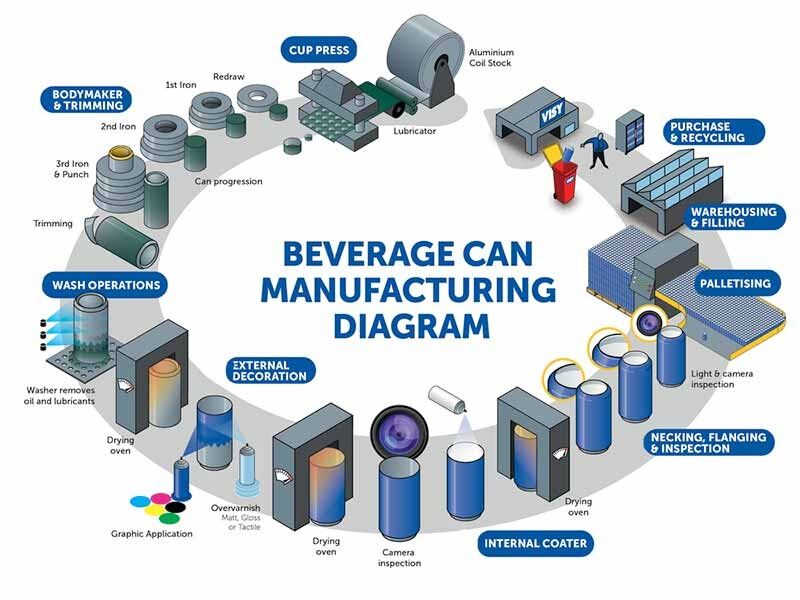
X. The Complete Closed-Loop Lifecycle
Integrating these technical phases reveals that an aluminum can is an continuous engineering system:
From raw sheet metal to thermal remelting, the aluminum can represents a harmony between high-speed industrial manufacturing and sustainable circular packaging design.
XI. ERJIN PACK: Integrated Beverage Packaging & Turnkey Sourcing
Selecting an aluminum can supplier requires more than comparing quotes. It demands an asset-backed manufacturing partner that understands container mechanics, filling dynamics, and export logistics.
At ERJIN PACK (Erjin Industrial), we assist global beverage brands, craft breweries, and contract packers in specifying, decorating, and delivering high-performance packaging matrices tailored to international markets.
Our Turnkey Product & Service Portfolio Includes:
-
Comprehensive Can Formats: Standard, Sleek, Slim, and Stubby profiles 250ml, 330ml, 355ml, 473ml, 500ml).
-
Advanced Lithography: High-definition 6-to-8 color printing including Glossy, Matte, White Base, and Tactile sensory finishes.
-
Certified Protective Liners: Verified food-grade Epoxy and eco-compliant BPANI internal barrier coatings.
-
Lid & End Matching: Full compatibility across 200, 202, and 206 easy-open ends with custom colored tabs and laser engraving.
-
Global Export Logistics: Multi-plant infrastructure delivering palletized shipments across Europe, North America, the Middle East, and Southeast Asia.
Whether you are launching a craft beer, sparkling water, energy drink, CSD, or RTD cocktail, our engineering team is ready to evaluate your target volume, formula characteristics, and line specifications to build a risk-free packaging strategy.
Contact ERJIN PACK today to request technical specification sheets, order print samples, or receive a factory-direct quotation for your upcoming packaging run.
Post time: Aug-26-2026


